Things to see · Churches and sanctuaries
Monastery of Santa Maria di Orsoleo
Sant'Arcangelo (Potenza)
Monastery of Santa Maria di Orsoleo is in Sant'Arcangelo, province of Potenza. Opening hours: Opening hours vary during the year: phone before your visit. Guided museum tours by booking, also outside opening hours for groups of at least 10 people. Admission: Church: free entry. Scenographic museum: details and prices when booking.
- Church: free entry. Scenographic museum: details and prices when booking.
- Opening hours vary during the year: phone before your visit. Guided museum tours by booking, also outside opening hours for groups of at least 10 people.
About this place
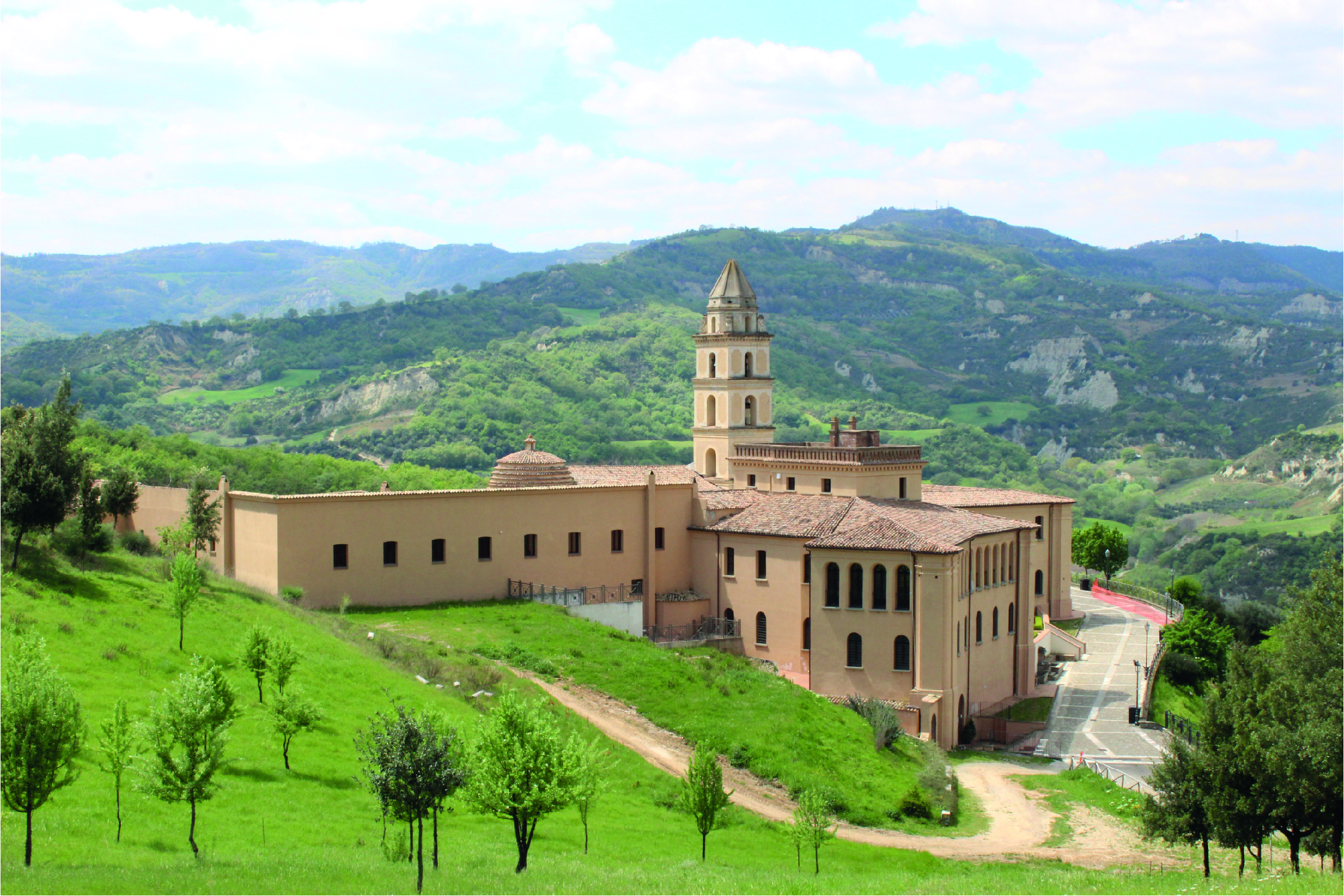
The monumental complex of Santa Maria di Orsoleo stands on top of a hill overlooking the Agri valley, about 4 kilometres from the centre of Sant’Arcangelo. The hill was once covered by thick woodland, and the convent stood isolated in the silence of the countryside. It is one of the finest monastic complexes in Basilicata: a richly decorated church, two cloisters with frescoes by Giovanni Todisco, a 31-metre bell tower and a statue of the Madonna that is among the oldest and most venerated in the region. Today the former convent also houses a multimedia museum.
The origins: a church in the “Orsolei valley”
The first records date from the last decade of the 12th century. Around 1192 the soldier Daniele and the priest Zaccaria began buying land in the valley called Orsolei, intending to build a church dedicated to the Virgin. The church was built above a cave already used for prayer by hermits and Italo-Greek monks. In 1272 it was run by Prior Daniele, followed by Prior Bonicio. In 1305 the bishop of Anglona complained to the Angevin king that the feudal lord of Sant’Arcangelo was trying to seize the abbey: a sign that the place was already important and wealthy.
The wooden statue of the Madonna and Child probably dates from the 13th century. It is an enthroned Madonna (Kyriotissa), covered with papier-mâché in the 18th century. It is still venerated today and celebrated every year on 8 September.
The name and the legends
According to popular tradition, the name Orsoleo comes from a bear (orso) and a lion (leone) seen at the foot of the oak where the image of the Madonna had appeared. Another version speaks of two pilgrims, Ursus and Leo, to whom the image was entrusted. Scholars prefer a Greek-Byzantine origin, from the words ouros and léos, “guardian” and “people”: the place from which the Madonna watches over the people of the valley.
Another legend says the convent was built as a thank-offering by Count Eligio della Marra, who with the Madonna’s help killed the dragon that was terrorising the countryside. A jawbone and tusks are still displayed in the church which, according to tradition, belonged to that very dragon.
The Franciscan convent
In 1474 Eligio II della Marra, prince of Stigliano and count of Aliano, had the convent built around the old church, enlarging it, and entrusted it to the Friars Minor of the Observance. The first, smaller cloister dates from that time; the larger cloister was added around 1600.
In 1545 the painter Giovanni Todisco from Abriola frescoed the smaller cloister and the loggia with scenes from the lives of Christ and Saint Francis: the Visitation, the Flagellation, the Angel Musicians, the Triumph of Faith, the great Triumph of Death and the Adoration of the Magi, the only work the painter ever signed. In 1614 the wooden choir behind the high altar was carved.
For centuries the convent was a centre of culture and learning known throughout the area and a place of welcome for pilgrims. It had a library, a pharmacy, a mill, an oven, an olive press, an ice house and two cisterns. An inscription over a door still reads: Foris non mansit peregrinus, ostium hoc viatori patuit, “no pilgrim was ever left outside: this door was always open to the traveller”.
The earthquake of 1654 damaged the complex, which was restored and reopened in 1673 by Bishop Orazio Fortunato. In the 18th century the church received its painted wooden ceiling and, in 1779, the polychrome marble high altar.
Decline, restoration and museum
With the suppression of religious orders after the Unification of Italy, the friars left the convent, which went through a long decline and was gradually abandoned. In 1973 the cloister frescoes were detached for restoration. From 1988 the complex underwent a major restoration; today it is owned by the Basilicata Region.
A multimedia scenographic museum has been set up in the rooms of the former convent. With large images, sound narration, video installations, holograms and 3D films, it tells the story of the ancient cults of this land, starting from the Byzantine saints of the 10th and 11th centuries, the daily life of the monks and the history of the Franciscan convent.
What to see
• The church, with a single nave, the 1664 portal topped by a classical pediment, the polychrome coffered wooden ceiling, stuccoed and gilded walls and the 1779 marble high altar.
• The statue of the Madonna of Orsoleo, from the 13th century, on the altar dedicated to her.
• The wooden choir of 1614, with carved panels: the Tree of Jesse, Christ blessing, the apostles and, among the figures, a Madonna and Child seated among the branches of a tree with a bear and a lion at her feet.
• The choir dome, with frescoes celebrating the Franciscan Order.
• The painting of the Madonna and Child with Saints Anthony and Mary Magdalene, attributed to Antonio Stabile (around 1580).
• The bell tower, 31 metres high, with an octagonal lantern decorated with animal sculptures, four large pine cones and a band of glazed tiles.
• The two cloisters and Giovanni Todisco’s frescoes in the smaller cloister.
• The scenographic museum in the rooms of the convent.
Nearby
On the road up to the convent stands the Torre Molfese, perhaps an ancient watchtower that protected travellers on their way to Orsoleo. Also in the Sant’Arcangelo area is the Torretta Sansanelli. Within a few kilometres you can reach the Pertusillo lake, Aliano with its badlands and the other villages of the Val d’Agri.
How to get there
• By car: from Sant’Arcangelo follow the signs for Santa Maria di Orsoleo along Via Orsoleo for about 4 kilometres.
• From Potenza: drive south-east through the Val d’Agri, in about an hour and a half.
• From Matera and the Ionian coast: drive up the Agri valley along the SS598 Fondovalle dell’Agri road, in about an hour and a half.
Useful information
• Address: Via Orsoleo, 85037 Sant’Arcangelo (PZ)
• The feast of the Madonna of Orsoleo is celebrated on 8 September.
• Opening hours of the church and the museum change during the year, and at times the museum has been closed. It is best to phone before your visit.
• Guided tours of the museum are also available outside opening hours for groups of at least 10 people, booked in advance: tel. +39 349 4546576 or +39 346 7950728.