Travel guide · Basilicata
Murgia Materana Park: itineraries and what to see
The Murgia Materana Park opposite the Sassi: Murgia Timone viewpoint, rock churches, Neolithic villages, Trail 406, walking itineraries and 2026 tickets.
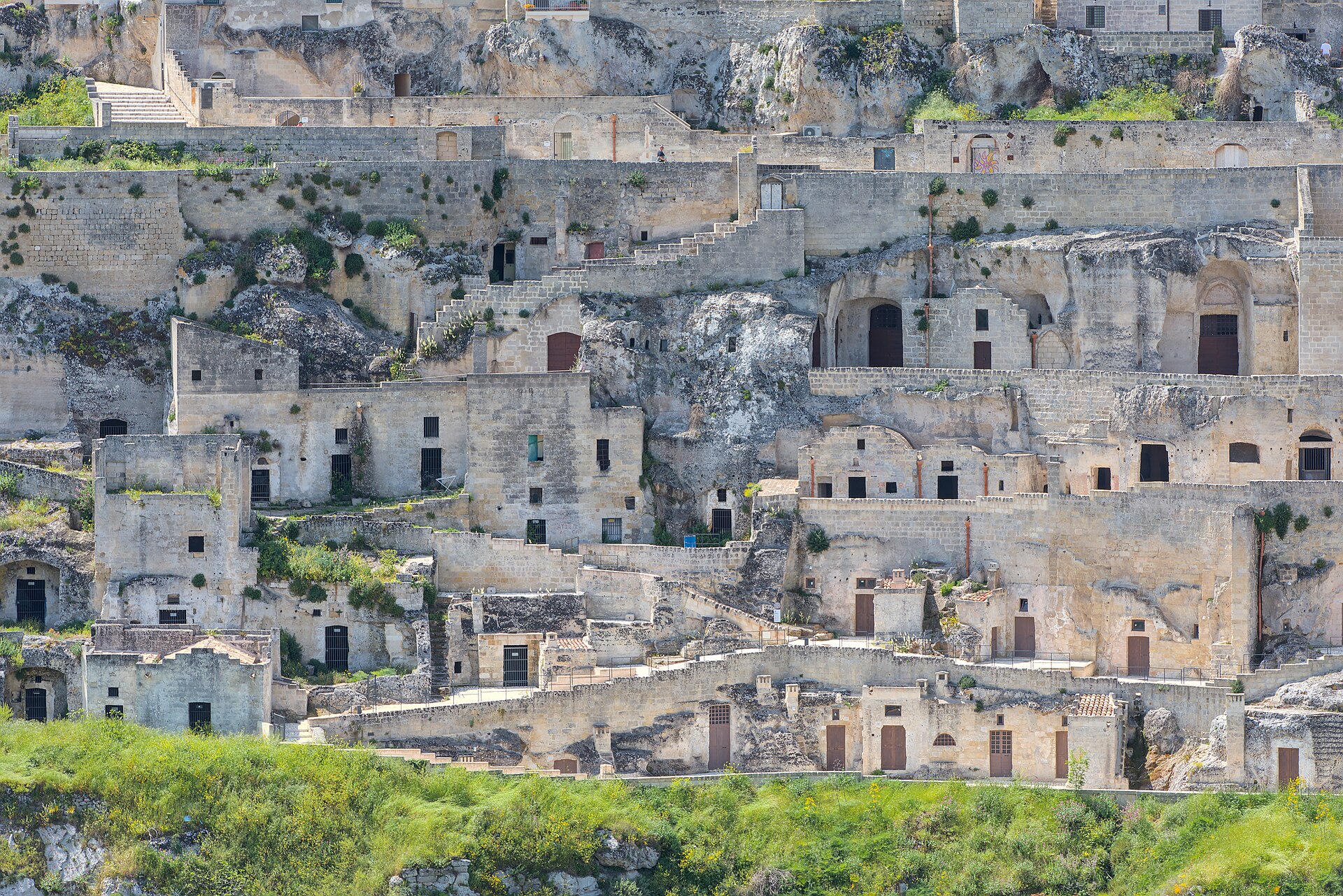
Foto: Benjamin Smith – CC BY-SA 4.0, Wikimedia Commons
The Murgia Materana Park, officially the Historical, Archaeological and Natural Park of the Rock Churches of Matera, is the other half of Matera. Opposite the Sassi, beyond the deep canyon of the ravine, lies a limestone plateau full of caves, prehistoric villages, farmsteads and about 150 rock churches carved by monks in the Middle Ages. Established in 1990, it protects more than 6,000 hectares between Matera and Montescaglioso and since 1993 it has been a UNESCO World Heritage Site together with the Sassi, as «The Sassi and the Park of the Rupestrian Churches of Matera». This guide covers what to see, walking itineraries and practical information for your visit.
The towns of the park
The park covers the territory of two towns: Matera, with the heart of the park on the Murgia Timone plateau right in front of the Sassi, and Montescaglioso, where the ravine drops towards the Bradano and the abbey of San Michele Arcangelo houses another park visitor centre.
The ravine and the plateau
The Gravina di Matera is a canyon carved into the limestone by the Gravina stream, which runs past the Sassi, near Montescaglioso and after about twenty kilometres flows into the Bradano. Its walls are full of caves, both natural and man-made. Above it lies the Murgia, a rocky plateau covered with Mediterranean scrub and pasture, a continuation of the Murgia of Puglia. The landscape changes a lot with the seasons: green and in bloom in spring, golden and sun-baked in summer.
What to see
The Murgia Timone viewpoint
From the edge of the Murgia, right in front of the city, you get the most famous view of Matera: the Sasso Caveoso, the Sasso Barisano and the Civita with the bell tower of the Cathedral, all at a glance. At sunset and in the evening, with the lights on in the Sassi, the view is unforgettable. Here on the plateau Mel Gibson set Golgotha in «The Passion of the Christ».
Prehistoric villages
The Murgia has been inhabited for thousands of years. There are caves already used in the Palaeolithic, such as the Grotta dei Pipistrelli (Bat Cave), and several Neolithic ditched villages, surrounded by moats cut into the rock. On the Murgia Timone plateau you can see the traces of one of these villages and some Bronze Age burials. The finds from these sites are kept in the Domenico Ridola Archaeological Museum in Matera.
The rock churches
From the early Middle Ages Benedictine and Byzantine monks carved churches into the rock, with one or more naves, apses, altars and domes hollowed out of the stone, decorated with frescoes and incised crosses. The best known in the park are:
- Madonna delle Tre Porte: on the edge of the ravine facing the Sassi, with frescoes of the Madonna and crosses carved into the rock.
- San Falcione: one of the churches closest to the Murgia Timone viewpoint, included in the visit to the area.
- Madonna della Croce and San Vito alla Murgia, on the plateau.
- Madonna delle Vergini, near the main road to Taranto.
- Cristo la Selva, hidden in the scrub.
- Not far from the ravine is the sanctuary of the Madonna della Palomba, partly carved into the rock and partly built.
Please note: the rock churches of the Murgia can be visited inside only on guided tours. In the city, however, you can visit Santa Maria de Idris, San Giovanni in Monterrone and San Pietro Barisano on your own with a ticket. In the countryside around Matera there is also the Crypt of Original Sin, the «Sistine Chapel of rock painting».
Jazzi and farmsteads
The Murgia has always been a land of shepherds and farmers. The jazzi were stone enclosures where flocks were sheltered; the masserie, often fortified, were the centres of large farms. Jazzo Gattini, at Murgia Timone, has been restored and is now the park’s visitor centre, with an environmental education centre.
The Montescaglioso side
In Montescaglioso the great Benedictine abbey of San Michele Arcangelo houses a park visitor centre. From here you can head down to the lower part of the ravine, with more rock churches and wilder, quieter landscapes.
Itineraries
Times are indicative. There is little shade and no water on the Murgia: always wear hiking shoes, bring water and a hat, and stay on marked paths to protect the archaeological remains and the vegetation.
1. Murgia Timone viewpoint and churches (easy)
This itinerary suits everyone, families included. Start from the Jazzo Gattini visitor centre, where you park, and reach the Murgia Timone viewpoint on foot (about one and a half kilometres) or by shuttle. Along the way you pass the rock church of San Falcione, the traces of the Neolithic village and the Bronze Age tombs; a short detour leads to the Madonna delle Tre Porte. Two or three hours are enough; the best time is late afternoon, to watch the sunset over the Sassi.
2. From the Sassi to the Murgia: Trail 406 (experienced hikers)
The most spectacular trail links the city and the park directly. It starts at Porta Pistola, on Via Madonna delle Virtù, in the Sasso Caveoso, drops steeply to the bottom of the ravine, crosses the stream on the suspension bridge and climbs the opposite side to the Murgia Timone viewpoint. It is short but tiring, with steep rocky sections: it is graded EE, for experienced hikers. Since 2026 access has been controlled by a checkpoint at Porta Pistola and a ticket is required. Avoid the hottest hours in summer and days with rain or strong wind.
3. The great loop of the Sassi and the ravine (guided)
For a full day on foot, park guides offer a loop of about four and a half hours linking the Sassi, the ravine and the plateau, with stops at rock churches and the best viewpoints.
4. Guided walks and experiences
- Viewpoint trail (about 2 hours 15 minutes): a guided walk between the viewpoint and the rock churches, with entry to the churches. Information and booking: the environmental education centre at Jazzo Gattini.
- Rock gardens (about 2 hours 15 minutes): a guided walk about the nature and plants of the Murgia.
- By bike: the plateau’s dirt roads are great by mountain bike too; find ideas in our guide Basilicata by bike.
An idea for the day
Morning in the Sassi, with the Cave House and the rock churches of the Monterrone; lunch in town; in the afternoon drive (or, for experienced hikers, walk Trail 406) to Murgia Timone to visit the rock churches and wait for sunset at the viewpoint. For everything else in the city read our complete guide to Matera.
Nature
- Plants: more than 900 plant species have been recorded in the park, many rare or endemic. Thyme, silver sage, asphodels and spurges grow on the rocks; trees include Macedonian oak, holm oak, downy oak and the valonia oak, whose only site in Basilicata is here.
- The lesser kestrel: the park’s symbol. This small migratory falcon arrives in spring and nests in large colonies, even on the roofs and in the cavities of the Sassi.
- Other wildlife: birds of prey include the Egyptian vulture, Europe’s smallest vulture, the red kite and the buzzard; on the ground porcupines, foxes, badgers, hares and wolves; reptiles include the four-lined snake and the leopard snake.
The park in the movies
The Murgia and the ravine are a natural film set: between the Sassi and the Murgia Pier Paolo Pasolini shot «The Gospel According to St. Matthew» and Mel Gibson «The Passion of the Christ», with the crucifixion set on Murgia Timone. Many visitors still come to the viewpoint to find the film’s shots.
Practical information
- Getting there by car: from Matera take the SS7 towards Taranto/Laterza. At km 583 turn following the signs «Centro visite» and «Area attrezzata camper» (not the first turning, which leads to the Madonna delle Vergini, but the next one) to reach Jazzo Gattini, where you park.
- On foot from the Sassi: via Trail 406 from Porta Pistola, for experienced hikers only.
- Tickets (2026): since 2026 the Murgia Timone area has an entrance fee. According to information published in August 2026, the viewpoint ticket costs €10 from April to October and €7 from November to March and includes the area’s trails, entry to San Falcione, the visitor centre, the shuttle to the viewpoint and toilets; Trail 406 costs €15 from April to October and €10 from November to March. Free for residents of Matera and Montescaglioso and children under six, 50% off for under-25s. Check current prices and times before you go.
- Visitor centre and guides: Jazzo Gattini environmental education centre, tel. +39 0835 332262 or +39 388 8925407, [email protected].
- When to go: spring, with flowers and the return of the lesser kestrel, and autumn are the best seasons. In summer walk early in the morning or at sunset. In winter the light is crystal clear, but rain, wind and ice make the paths slippery.
- Respect: stay on the paths, don’t pick plants or stones, don’t enter closed churches and take your rubbish with you.
- Nearby: for towns and events in the area open the Matera and the Murgia area; Montescaglioso is also in our guide The most beautiful villages of Basilicata.