Travel guide · Basilicata
Carnival in Basilicata: the 9 historic masks
Basilicata's historic carnivals: Aliano's horned masks, Tricarico's cows and bulls, Satriano's Rumita, Lavello's Domino and the other rituals, town by town.
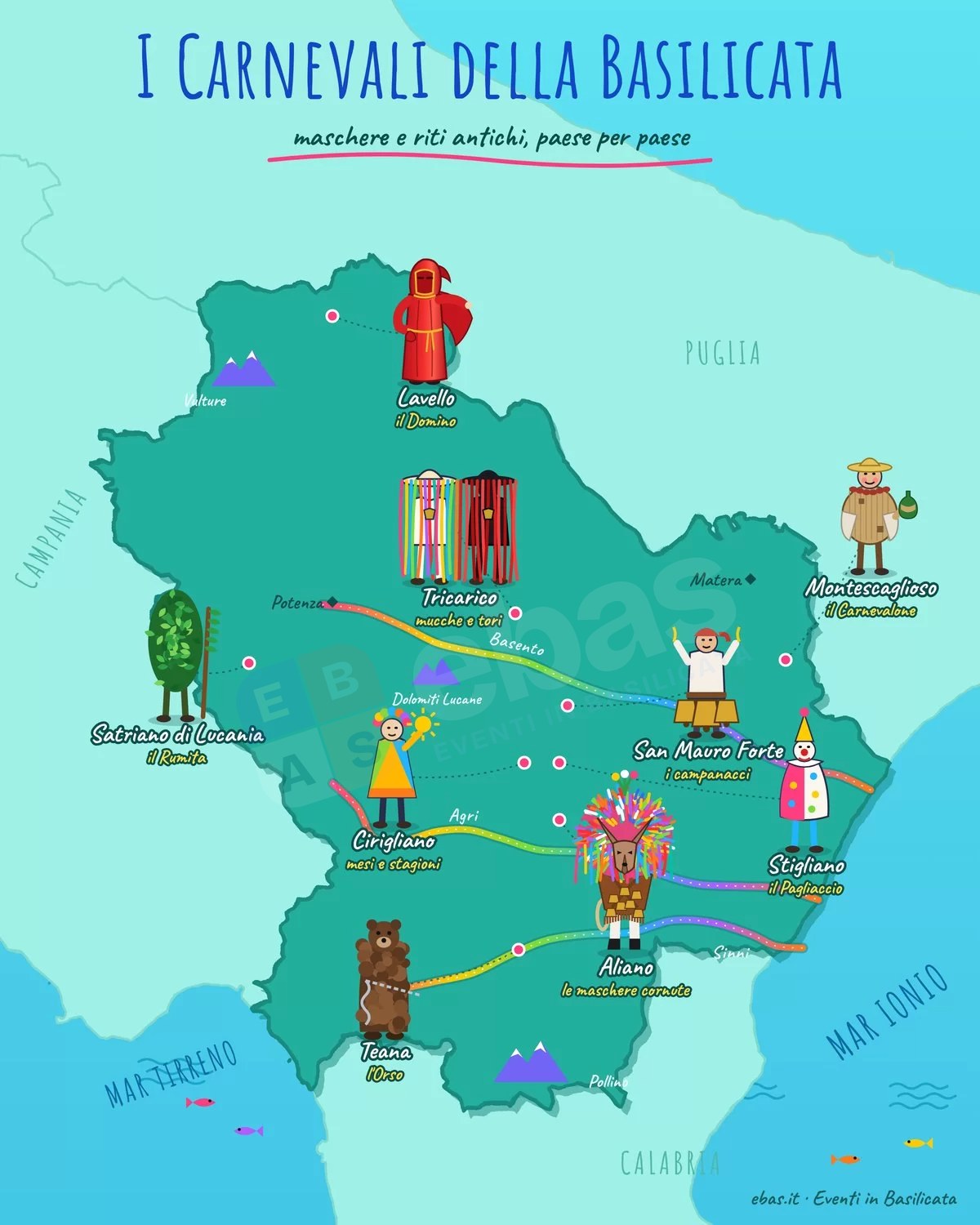
In Basilicata, Carnival is above all a farming ritual: animal masks, men dressed as trees, cowbells ringing through winter nights, jokes and satire about village life. Nine towns belong to the Network of Historic Carnivals of Basilicata, each with its own symbolic mask. The season starts in mid-January, with the feasts of Saint Anthony the Abbot, and ends on Shrove Tuesday, often with the burning of the Carnival figure.
Aliano: the horned masks
Aliano’s masks are among the most spectacular in southern Italy. On their heads they wear a huge headdress of coloured paper strips topped with flowers and sprigs; on their faces, papier-mâché masks with horns, long noses and devilish or animal features. They wear fringed woollen shawls, leather straps crossed over the chest and loaded with cowbells, and often a coiled rope at the hip. On the last Sunday of Carnival, «la frase» is performed: rhyming satire about local events and people.
Tricarico: cows and bulls
In Tricarico the masks (l’màshkr) recall the seasonal migration of herds. The cows are dressed in white, with a wide-brimmed hat, a veil and long coloured ribbons down to the ankles; the bulls are all in black with red ribbons. With their cowbells and led by the herdsman, they roam the town from the feast of Saint Anthony the Abbot. On Shrove Tuesday the Carnival puppet is burned in the square.
San Mauro Forte: the cowbells
For Saint Anthony the Abbot, in mid-January, groups of men with large cowbells tied at the waist walk through San Mauro Forte late into the night, ringing them all together. It is the sound that opens Carnival; along the way people offer sausage, taralli, focaccia and wine.
Satriano di Lucania: the Rumita
The Rumita is a tree-man covered in ivy from head to toe: he walks in silence, knocks on doors with his stick and receives an offering in exchange for wishes of a good harvest. The Bear and Lent (Quaresima) parade alongside him. The most famous parade is «the walking forest», with hundreds of Rumiti in the streets.
Teana: the Bear
Teana’s symbolic mask is l’Urs, the Bear, a reminder of the bond between people and nature. The costumes are hand-sewn by local volunteers and craftspeople. Teana’s Carnival is also an ironic festival that stages village life and its characters.
Cirigliano: the months and the seasons
In Cirigliano the masks of the twelve months and the four seasons parade, led by New Year: each mask recites its own monologue, adults and children together. It is a tradition of medieval origin that ends with Quaremma (Lent) walking behind the Carnival’s coffin.
Stigliano: the Clown
Stigliano has chosen the Clown (il Pagliaccio) as its symbolic mask, opening and leading the festivities through the streets. Stigliano’s Carnival is also famous for its parades of allegorical floats: papier-mâché floats built over several weeks by local groups, parading amid music, masks and confetti, often with ironic themes about current events. Each year’s programme is on the town page on Ebas.
Lavello: the Domino
Lavello’s Domino is an elegant mask in red satin: a hood with a mask covering the face, a cape, a long tunic, a cord at the waist and a small bag. It is the mask of the Carnival balls, all about gallantry: the Domino never leaves his lady until the end of the dance, walks her back to her seat and gives her sweets, chocolates and cumbitt, sugared almonds.
Montescaglioso: the Carnevalone
In Montescaglioso the Shrove Tuesday parade ends with the Carnevalone, who arrives in silence riding a donkey and is finally burned. Masks were once made of animal skins and jute; traditional figures include the Fate with her spindle, Quaremma dressed in black and the Carnevalicchio in a wheelbarrow. The Carnevale Montese, with its papier-mâché floats, is one of Italy’s historic carnivals.
In early January Montescaglioso also holds the night of the Cucibocca: figures cloaked in black, with long white beards, wandering the alleys with lanterns.
Tips for enjoying the carnivals
- Dates: they change every year with the date of Easter; between January and Shrove Tuesday you will find them in the Ebas calendar and on the town pages.
- In the evening: many rituals take place after dark and outdoors, in hill and mountain towns — bring warm clothes and comfortable shoes.
- Respect: the masks are a living tradition of these communities; take photos, but don’t get in the way of the parades.
- Several towns in one day: Aliano, Stigliano, Cirigliano and San Mauro Forte are close to each other — add them to your itinerary with “Plan your trip”.