Travel guide · Basilicata
Matera: complete guide to the Sassi and the Murgia
Matera: what to see in the Sassi, viewpoints, rock churches, museums, the Murgia, the Bruna feast, 1-3 day itineraries and practical tips.
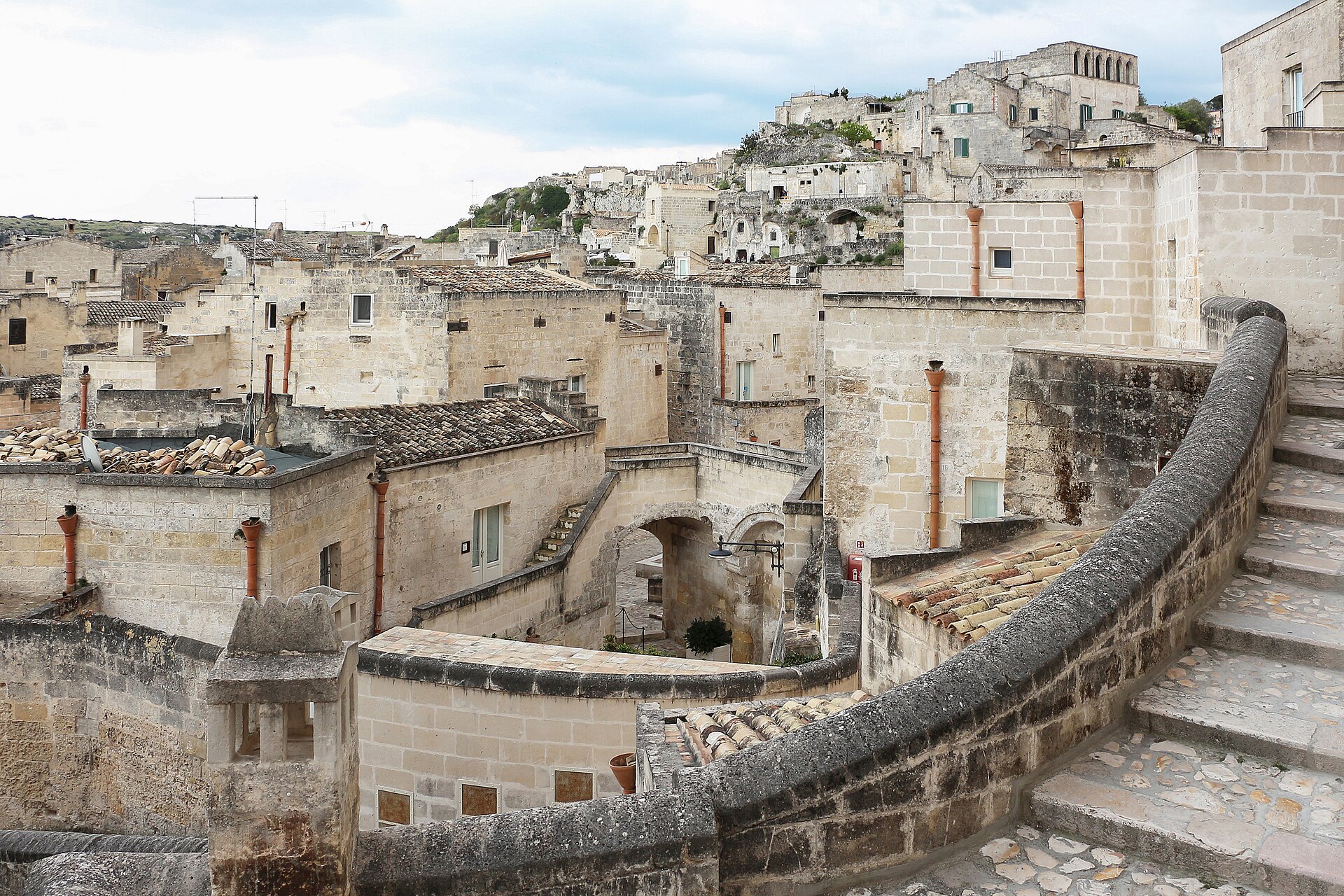
Foto: Bernard Gagnon – CC BY 4.0, Wikimedia Commons
Matera is one of the oldest continuously inhabited cities in the world and Basilicata’s best-known destination. Its Sassi, two districts of houses, churches and cisterns carved into the limestone along the Gravina ravine, have been a UNESCO World Heritage Site since 1993 together with the Park of the Rock Churches of the Murgia. In the 1950s they were called a “national disgrace” for the poverty of the people living there; today, after evacuation, restoration and the title of European Capital of Culture 2019, they are one of the most moving urban landscapes in Europe. In this guide you’ll find what to see, the viewpoints, the rock churches, the museums, the Murgia, one-, two- and three-day itineraries and practical tips.
How the city is laid out
Matera has two souls. Above is the Piano, the 17th- and 18th-century and modern town, with piazza Vittorio Veneto, via del Corso, via Ridola and the Baroque churches. Below, along the edge of the Gravina, are the two Sassi: the Sasso Barisano, to the north, facing Bari, with more built façades, doorways and small palaces; and the Sasso Caveoso, to the south, the oldest and most “carved”, laid out like an amphitheatre with cave houses and rock churches. Between them, on the highest spur, is the Civita, the original fortified core, crowned by the Cathedral. Opposite, beyond the stream, stretches the Murgia Materana plateau.
The viewpoints: Matera from above
- Piazza Vittorio Veneto: from the balcony you see the Sasso Barisano; beneath the square is the Palombaro Lungo.
- Belvedere Luigi Guerricchio, in piazza Pascoli: the widest view over the Sasso Caveoso and the Civita, beautiful at sunset.
- Piazzetta del Duomo and the Sant’Agostino viewpoint: views over the Barisano and the Gravina.
- Murgia Timone viewpoint, on the opposite side of the Gravina: this is where you see the whole city, like a postcard. You can drive there from the Laterza road or walk down from the Sasso Caveoso and cross the Tibetan bridge over the stream.
What to see in the Sassi
The Cathedral and the Civita
The Cathedral of the Madonna della Bruna and Sant’Eustachio, in Apulian Romanesque style, was completed in 1270 on the highest point of the Civita. It has a large rose window, a bell tower over 50 metres tall and, inside, Baroque decoration, a fresco of the Last Judgement and Altobello Persio’s 16th-century stone nativity scene. Around it, the lanes of the Civita hold noble palaces and glimpses of the Gravina.
The rock churches
The Sassi and the Murgia hold over 150 rock churches, carved into the tuff between the early Middle Ages and the modern era, many with Byzantine and medieval frescoes. The most visited in town are:
- Santa Maria de Idris and San Giovanni in Monterrone, on the Monterrone crag in the middle of the Sasso Caveoso, with frescoes from the 12th to the 17th century.
- Madonna delle Virtù and San Nicola dei Greci, a two-level rock complex overlooking the Gravina, often used for exhibitions.
- Santa Lucia alle Malve, one of the oldest, founded as a Benedictine convent.
- San Pietro Barisano, the city’s largest rock church, with an 18th-century façade and the crypt where the bodies of the dead were drained.
In the countryside outside town, at Pietrapenta, is the Crypt of Original Sin, called “the Sistine Chapel of rock painting”: a cycle of 8th–9th-century frescoes with the Creation and the story of Adam and Eve. Visits are by booking only.
Cave houses and the Palombaro Lungo
To understand how people lived in the Sassi until the 1950s, step into a furnished cave house, such as the one in vico Solitario in the Sasso Caveoso: a single carved room where the family slept alongside the animals, with the cistern, the stable and the high bed. Under piazza Vittorio Veneto you can visit the Palombaro Lungo, a huge cistern carved into the rock, about 15 metres deep, that collected water for the city: proof of how sophisticated the Sassi’s water system was.
San Pietro Caveoso and the Sasso Caveoso
The church of San Pietro Caveoso, overlooking the Gravina at the foot of the Monterrone crag, is one of the most photographed places in Matera. From here a path leads down to the stream and up to the Murgia. Walking through the Caveoso you’ll find stairways, gardens, terraces and roofs that serve as streets for the houses above.
Tramontano Castle
On the Lapillo hill above the city stands Tramontano Castle, begun in the early 16th century by Count Giancarlo Tramontano and left unfinished: the count was killed by the people of Matera in 1514, exasperated by his taxes. The keep and two towers remain, in a public park with a fine view.
Museums
- Domenico Ridola National Archaeological Museum: finds from prehistory to the Hellenistic age from Matera and its territory, from the Neolithic villages of the Murgia to tombs with Greek and Apulian pottery.
- Palazzo Lanfranchi (National Museum of Medieval and Modern Art of Basilicata): works from the Middle Ages to the 20th century and the room with Carlo Levi’s huge canvas Lucania ’61.
- MUSMA, the Museum of Contemporary Sculpture, set in the caves and rooms of Palazzo Pomarici in the Sasso Caveoso: one of Italy’s most evocative museums.
- Casa Noha and the other house museums of the Sassi tell the city’s story, from evacuation to restoration, with videos and displays.
The Murgia Materana
The Historical, Archaeological and Natural Park of the Rock Churches of Matera, the Murgia, covers the plateau facing the Sassi and the Gravina as far as Montescaglioso. It is a landscape of stone, Mediterranean scrub and pastures, with rock churches, jazzi (old sheepfolds), entrenched Neolithic villages such as Murgia Timone and Murgecchia, and caves inhabited for millennia. The visitor centre is at Jazzo Gattini, near the Murgia Timone viewpoint. Trails are marked; in summer start early and bring water, as there is no shade.
Matera in the movies
Many directors have chosen the Sassi for their resemblance to ancient Jerusalem and for their light. Pier Paolo Pasolini shot The Gospel According to St. Matthew (1964) here and Mel Gibson The Passion of the Christ (2004); in 2021 the city was the set for the opening scenes of No Time to Die, with James Bond chased through the stairways and over the Gravina bridge. It is not unusual to come across film sets and crews even today.
Festivals and events
- Feast of the Madonna della Bruna, 2 July: the patron saint’s feast, with the shepherds’ procession at dawn, the procession of the papier-mâché triumphal cart and, in the evening, the “assault on the cart”, which the crowd tears apart in the square. Whoever grabs a piece takes it home as a keepsake and good-luck charm. Fireworks over the Murgia close the day.
- Christmas: lights, markets and, in many years, a living nativity scene among the caves of the Sassi.
- Concerts, exhibitions and festivals take place all year round: find them in the Ebas calendar, along with events in the surrounding towns.
What to eat
- Pane di Matera PGI: durum wheat bread with a thick crust and a “cornetto” or “coppola” shape; it keeps for days.
- Crapiata: a soup of pulses and wheat made in August, a peasant tradition.
- Cialledda: stale bread with tomato, onion, oil and oregano in summer, or in broth with eggs in winter.
- Peperoni cruschi (crunchy dried peppers), fave e cicorie (broad beans and chicory), orecchiette and strascinati with meat sauce or turnip tops, lamb pignata.
- For sweets and wine: almond strazzate and Matera DOC wine from the province.
Itineraries: one, two or three days
One day
Morning in the Sasso Barisano and the Civita with the Cathedral; then the Palombaro Lungo and a cave house. Afternoon in the Sasso Caveoso: Santa Maria de Idris, San Pietro Caveoso and MUSMA. At sunset the Guerricchio viewpoint in piazza Pascoli, dinner in the Sassi.
Two days
On day two, cross the Gravina: walk down from the Sasso Caveoso to the Tibetan bridge and climb up the Murgia to the Murgia Timone viewpoint and the rock churches. In the afternoon, the Ridola Museum or Palazzo Lanfranchi, then the Crypt of Original Sin if you have booked.
Three days or more
Use Matera as a base: Montescaglioso and the abbey of Sant’Angelo, Miglionico and its Malconsiglio castle, the Collina Materana with Craco and the badlands of Aliano, or the sea and temples of Metaponto, less than an hour away. Altamura, Gravina in Puglia and Alberobello, in Apulia, are close by.
Getting there and getting around
- By plane: the nearest airport is Bari, about 65 km away. Shuttles and buses run to Matera; by car it takes just over an hour.
- By train: Matera is not on the national rail network. It is served by the Ferrovie Appulo Lucane line from Bari, or you can take the train to Ferrandina or Bari and continue by bus.
- By car: the old town and the Sassi are a limited traffic zone. Leave your car in the car parks around the centre and walk.
- On foot: the Sassi are all stairways and slopes. Wear comfortable shoes; with pushchairs or reduced mobility, ask about the easiest routes and shuttle services.
When to go and tips
- Spring and autumn are the best times: mild weather and beautiful light. Summer is hot, especially on the Murgia: visit early in the morning and in the evening.
- On 2 July the city celebrates and is very crowded: book well in advance.
- In the evening the illuminated Sassi are a sight: it’s worth staying at least one night in town, perhaps in a cave hotel.
- Respect: people live in the Sassi. Don’t enter private caves, leave no litter and don’t climb on roofs and walls.
Find where to stay and eat in Matera in the Ebas sections, or add the city’s sights to your itinerary with “Plan your trip”. To discover the surrounding towns, open the Matera e la Murgia area.