Travel guide · Basilicata
Collina Materana: a guide to the villages of the badlands
Collina Materana: Aliano and Carlo Levi's badlands, the ghost town of Craco, Accettura's Maggio, Stigliano and the hill villages of inland Matera.
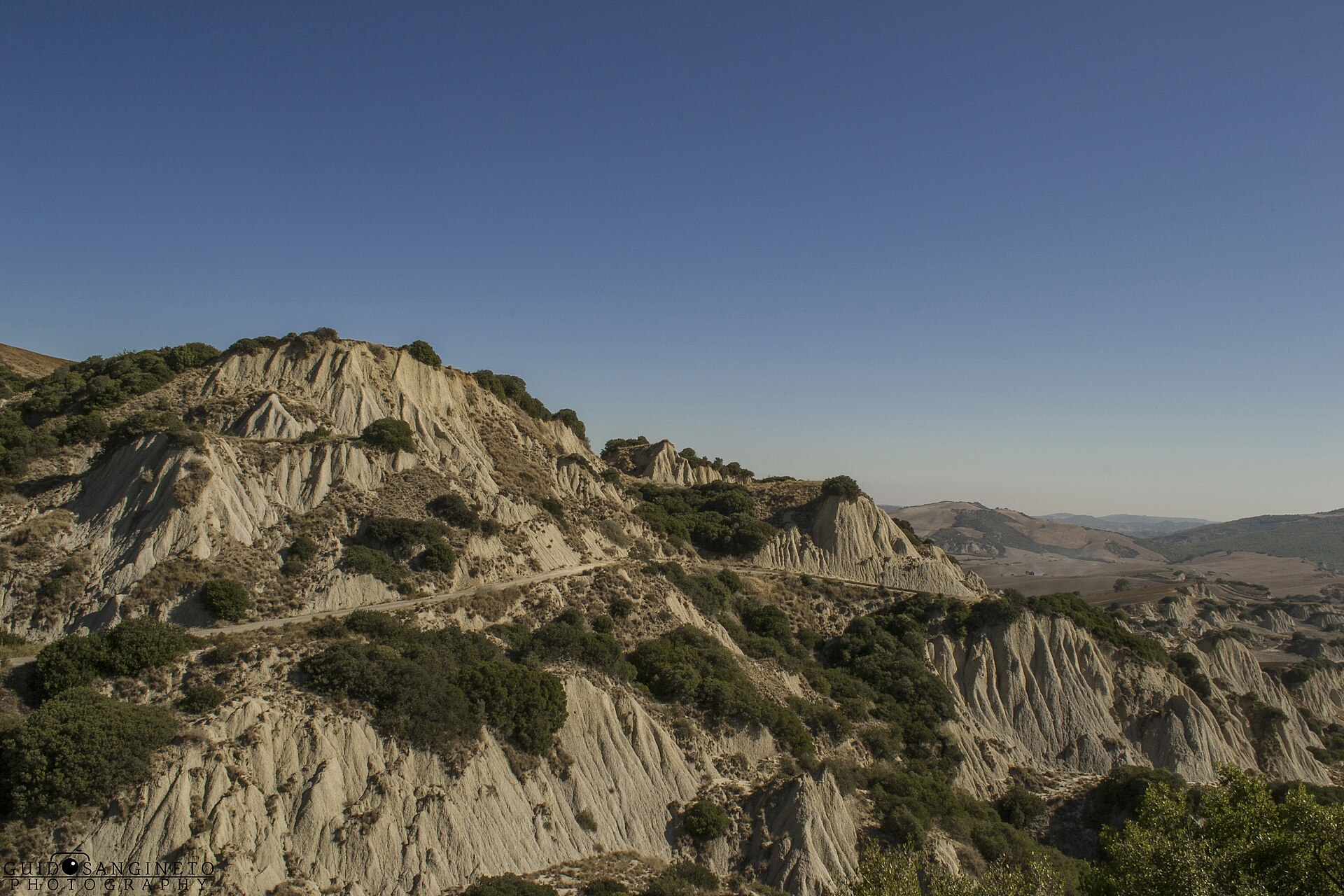
Foto: Guidos24 – CC BY-SA 4.0, Wikimedia Commons
The Collina Materana is the inland heart of the province of Matera: a land of clay hills, water-carved badlands (calanchi), woods and hilltop villages, between the Basento, Cavone, Salandrella, Sauro and Agri valleys. Less than an hour from Matera and the Ionian Sea, it is Basilicata at its most authentic: villages of a few hundred or a few thousand people, ancient rituals, country cooking and almost lunar landscapes. It is also the land of Carlo Levi and Christ Stopped at Eboli.
The villages of the Collina Materana
There is no single official boundary: in this guide we include the hill villages between the Basento and the Agri. Seven of them, Accettura, Aliano, Cirigliano, Craco, Gorgoglione, San Mauro Forte and Stigliano, form the Union of Municipalities of the Collina Materana, based in Stigliano.
What to see
Aliano: the badlands and Carlo Levi
Aliano overlooks one of the most spectacular badland landscapes in Italy. The Turin writer and painter Carlo Levi was sent here in internal exile by the Fascist regime in 1935–36, and asked to be buried here: the village is the “Gagliano” of his book. You can visit his house of exile, the gallery with his works, the museum of peasant life and the places of the Carlo Levi Literary Park. In August the festival La luna e i calanchi brings poets, musicians and travellers; at carnival the horned masks parade, among the most beautiful in southern Italy.
Craco: the ghost town
Old Craco, perched on a ridge beneath its Norman tower, was abandoned after the 1963 landslide and is now one of the world’s most famous ghost towns. Its empty houses have been the set of many films, from Francesco Rosi’s Christ Stopped at Eboli to Mel Gibson’s The Passion of the Christ and Quantum of Solace. The village is visited on a guided route with a helmet; residents now live down in the valley, at Craco Peschiera.
Stigliano, Cirigliano and Gorgoglione
Stigliano, at over 900 metres, is the highest town in the province of Matera and the seat of the Union: it has a large old town, churches and convents and a carnival with parades of allegorical floats. Cirigliano is a small medieval village enclosed by walls and towers, with a feudal castle and its oval tower, and a carnival dedicated to the seasons. Gorgoglione looks over the Agri valley and is known for its sandstone, the “pietra di Gorgoglione”, used for doorways and houses.
Accettura and the Maggio
Accettura is the village of the Maggio di San Giuliano, one of Italy’s best-known tree rituals: at Pentecost a huge Turkey oak from the Montepiano wood is hauled into the village by oxen and “married” to the top of a holly from the Gallipoli Cognato forest, then raised in the square. The village is a gateway to the Gallipoli Cognato and Lucanian Little Dolomites Park, with beech woods, trails and picnic areas.
San Mauro Forte: the tower and the cowbells
San Mauro Forte grew up around a Benedictine monastery and keeps its three-storey Norman tower in the main square and one of the old gates of the fortified village. The name “Forte” recalls how it held off Borjes’s bands in 1861. On 16 January, for Saint Anthony the Abbot, groups of men walk the village ringing huge cowbells late into the night: one of the region’s oldest and most stirring festivals.
Tricarico, Grassano and Grottole
Tricarico, a bishop’s seat, has one of Basilicata’s best-preserved medieval old towns, with its Norman tower and the Rabatana and Saracena quarters of Arab origin; it is the home of the poet Rocco Scotellaro and of the carnival with cow and bull masks. In Grassano Carlo Levi spent the first months of his exile before being moved to Aliano. Grottole keeps the ruins of its castle and of the great roofless church of Saints Luke and Julian, and overlooks Lake San Giuliano, a nature reserve.
The Basento valley: Ferrandina, Salandra, Garaguso, Oliveto Lucano and Calciano
Ferrandina, overlooking the Basento valley, is the home of the majatica olive, oven-baked here into a local speciality. Salandra has the convent of Sant’Antonio, Garaguso is famous for the small marble temple of a Greek sanctuary found on its land, now in the Potenza archaeological museum. Oliveto Lucano and Calciano are small villages inside the Gallipoli Cognato Park, ideal for silence and trails.
Landscapes and nature
- The badlands: clay hills carved by rain into ridges and gullies that change colour with the light. The finest spots are around Aliano, Craco and along the road between Stigliano and Aliano; at sunset they are unforgettable.
- The Gallipoli Cognato forest: over 4,000 hectares of oaks and beeches between Accettura, Calciano and Oliveto Lucano, with the Palazzo visitor centre, trails, free-roaming horses and the remains of an ancient Lucanian fortification on Monte Croccia.
- Lake San Giuliano, near Grottole: a nature reserve visited by migrating birds.
- The river valleys: the Basento, Cavone, Salandrella and Agri shape the area and are best explored by car, motorbike or bike.
Festivals and traditions
- January: the cowbells of San Mauro Forte and the cows and bulls of Tricarico for Saint Anthony the Abbot open the carnival season.
- Carnival: the horned masks of Aliano, the seasons of Cirigliano, the floats of Stigliano. You’ll find them all in our guide Carnivals of Basilicata.
- Pentecost: the Maggio of Accettura.
- Summer: the La luna e i calanchi festival in Aliano, food fairs and patron saint feasts in every village.
- Festivals and food fairs are in the Ebas calendar: add them to your itinerary with “Plan your trip”.
Flavours
The cooking is peasant food: home-made pasta such as strascinati, ferretti and cavatelli, crunchy dried peppers (peperoni cruschi), sausage and soppressata, sheep and goat cheeses, pulses, extra virgin olive oil and Ferrandina’s majatica olive. At summer food fairs you can taste dishes that are hard to find anywhere else.
Getting there and when to go
- By car: from the Basentana highway (SS407) you climb to the villages from Ferrandina, Salandra or Grassano; from Matera it takes about an hour, from the Ionian coast you drive up via Pisticci or Montalbano. A car is the most practical option: the villages are linked by scenic but slow hill roads.
- When: spring and autumn are perfect for the badlands and trails; summer for festivals and food fairs, best in the morning and at sunset; winter for the Saint Anthony rituals and carnival.
- How long: in one day you can see Aliano and Craco; with a weekend add Stigliano, San Mauro Forte and Accettura; with three or four days you can tour the whole area.